
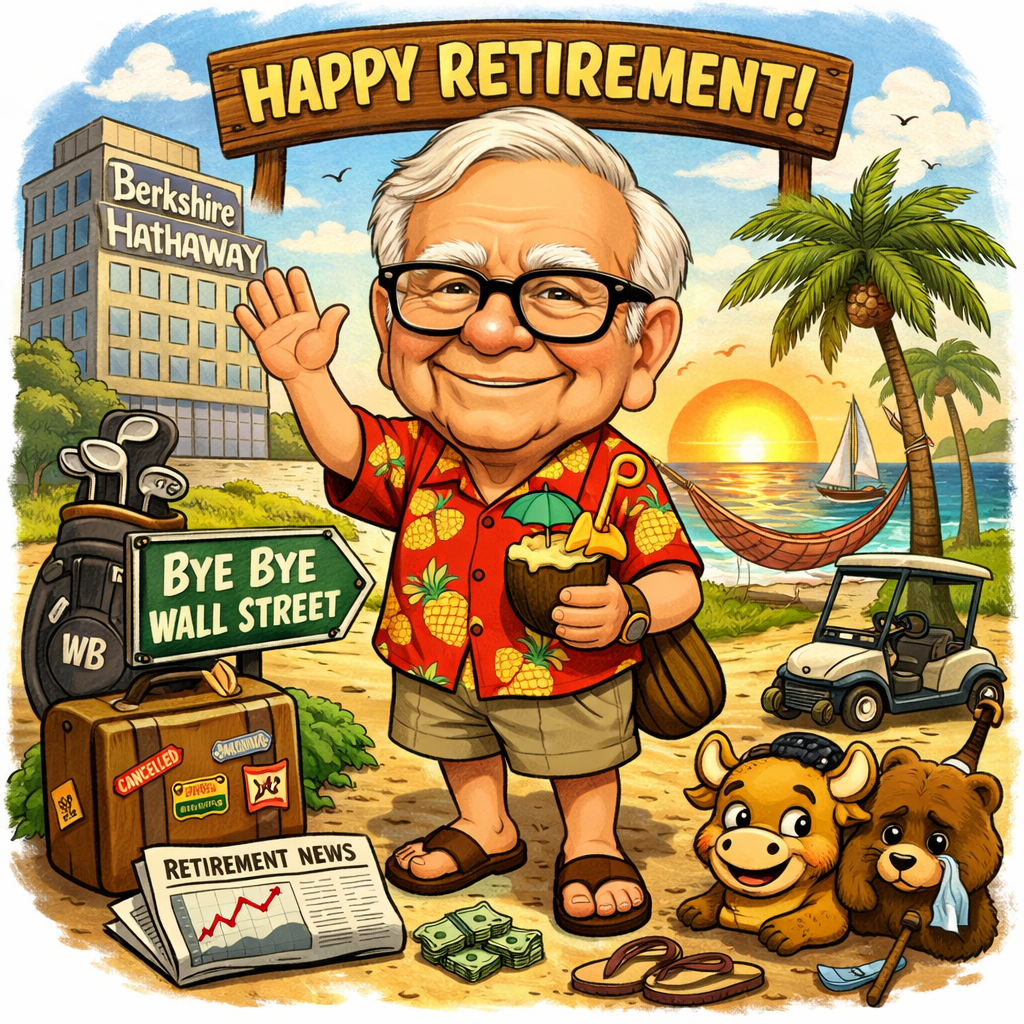

Wall Street’s closing bell on December 31, 2025 marked the end of the most storied career in financial history. Warren Buffett is officially stepping down as CEO of Berkshire Hathaway (BH), concluding a 60-year tenure which is unparalleled in the history of capitalism. Buffett isn’t just a centi-billionaire; he’s the undisputed Investing GOAT—the Greatest Of All Time.
Under his watch, a single share of BH’s Class A shares rose from a mere $7.50 in 1962 to a staggering $754,800 today. To put that in perspective, a modest $1,000 investment made at the start of his tenure would have compounded into a breathtaking $99,957,000 fortune! And, indeed, Buffett didn’t just make himself one of the wealthiest men on the planet; he minted a literal army of “Berkshire Millionaires” among ordinary people who had the discipline to stay for long chunks of the ride.
The masses love Buffett because he shared his wealth-creation prowess and process. Anyone could invest alongside him as an equal partner by purchasing shares in the company he led. Millions more learned from the investment and business lessons he shared widely and eloquently through his shareholder letters, speeches, and interviews. He lived and spoke like the common man. He leaves behind a rich legacy of financial wisdom to tap into.
Although I never met the Oracle of Omaha and, despite my famous public criticism of BH’s 401(k) plans, he’s one of my key investing mentors. My knowledge was tremendously enhanced by studying his biography and the 6 decades’ worth of his stock picks and business acquisitions, all laid out and explained in pithy shareholder letters available here.
Buffett felt it proper to share, in plain English, with his shareholders, whom he considered true partners, what was happening with their investment holdings. In his shareholder letters, he candidly and clearly explained the thought process behind his many successes and candidly reviewed his handful of miscues. Here are seven core “Buffettology” lessons that have broad application.
1. Risk Management: The “Never Lose Money” Math
Buffett always managed his downside risk. And he was the investment GOAT, not despite his risk aversion but because of it. He liked to say that: “Rule No. 1 is: Never lose money. Rule No. 2 is: Never forget Rule No. 1.”
This is more than a catchy slogan; it is a mathematical imperative for anyone who understands compounding. If you suffer a 50% loss in your portfolio, you don’t just need a 50% gain to get back on track—you need a 100% gain. And if you suffer severe losses, it becomes virtually impossible to recover.
Part of Buffett’s brilliance was in realizing and accepting that you don’t need to be greedy and try to win every inning. He DID need to avoid the “big error” that would take him out of the game. Staying alive allowed his relatively few outstanding investment selections to result in an overall major win. By maintaining an ironclad focus on downside protection, sometimes keeping a massive cash cushion, which sits at a colossal $358 billion as he retires, he ensured his compounding “snowball” could roll for eight decades without shattering.
2. Circle of Competence: The Power of the Perimeter
As a key part of this risk management, Buffett was famously the anti-FOMO guy, staying strictly within what he called his circle of competence. He would cite IBM’s Tom Watson: “I’m no genius, but I’m smart in spots, and I stay around those spots.”
This discipline was especially tested in the 1990s when his younger but close friend, Bill Gates, tried to convince him to buy a computer and invest in Microsoft. Buffett’s response was classic: “Will computers change whether people chew gum?” When Gates admitted it likely wouldn’t, Buffett replied, “Well, then I’ll stick to chewing gum, and you stick to computers.”
Buffett was referring to his significant investment in Wrigley’s, the very popular chewing gum brand, which had a real moat, as we’ll discuss next. While he missed the massive gains in Microsoft, Amazon, and Google, by refusing to bet on volatile businesses he didn’t understand, Buffett also avoided the many catastrophic tech blowups of the last 50 years. Remember Rule #1, right?
3. Wide Moats: Identifying Durable Advantage
Long-term investing is about identifying enduring value. Buffett stressed that he doesn’t just buy any business’s cash flow; he’s looking for an “economic castle” protected by an unbreachable moat. A moat is a durable competitive advantage—be it the brand power of Coca-Cola and American Express, or the low-cost structural advantage of GEICO and major railroad and utility companies he purchased outright.
This vein of reasoning is why I encourage people to think about their careers and businesses in terms of what might endure and compound over time. Although there are sometimes quick profits to be had, it’s exhausting and counterproductive to chase and ride new buzzy trends that are obviously going to fizzle out quickly.
4. Relentless Curiosity: The Knowledge Compound
Success, according to Buffett, is a result of letting your knowledge compound over time. He is a “reading machine,” famously spending 80% of his day with his nose in books and corporate reports. This curiosity allowed him to constantly learn, improve, and evolve even into his 80s and 90s.
There is no greater proof of this than his massive pivotal investment in Apple. As mentioned, he had avoided tech for decades, as it was beyond his circle of competence. But with relentless curiosity, he constantly expanded that circle!
By 2016, long after Apple’s founding, Buffett realised that Apple wasn’t just a moat-less “tech” company, which could be leapfrogged and crushed by a new invention. Steve Jobs had built an enduring brand, selling wildly “sticky” consumer electronics and services, maintaining a moat as wide as any he’d ever seen. So BH went in big, and at a time when the market thought Apple’s future had peaked. By the time of his retirement, his massive bet on Apple had created over $100 billion in profits for Berkshire!
BTW- Note how Buffett loaded up when prices were low (the blue line and left axis) and only began selling (the green bars and the right axis) as Apple reached its extraordinary heights.
Expand your circle of competence. And then, buy low. Sell high.
5. Contrarian Confidence: The Omaha Lonewolf
As he did with his great timing with Apple stock, Buffett was always able and willing to step away from the crowd. Indeed, Buffett’s choice to stay in Omaha, living in the same house since 1958, was a strategic shield against the “noise” of Wall Street and the buzz of the coastal cities. Great investing is about buying low and selling high, fighting FOMO and FOLO with detached confidence. This crucial soft skill is perhaps the most challenging part of investing!
By insulating himself, physically and mentally, he maintained the emotional distance needed to be “fearful when others are greedy and greedy when others are fearful.” This confidence allowed him to avoid getting sucked into overpriced markets or panic during gloomy times, and to recognize the hidden value that the herd missed.
6. Good People: The “Three Qualities” Rule
“You can’t make a good deal with a bad person” is a core Buffett tenet I love. When evaluating partners, he looked for three things: “intelligence, energy, and integrity.” He warns that if a person lacks the third element, the other two qualities become quite dangerous! Some of Buffett’s associates consider his ability to quickly and accurately sniff out people as his most remarkable trait.
A legendary example of his ability to read, trust, and deal with fantastic people was his 1983 purchase of Nebraska Furniture Mart from Rose Blumkin, a Russian-born Jewish immigrant. Buffett bought 90% of the company for $60 million on a simple handshake deal and a one-page contract. He didn’t even audit her books; he simply trusted her character and “the way she ran rings around” everyone else. Buffett sniffed out her top-level talent, energy, and integrity, and let her do it her way. They made a fortune together.
7. The Inner Scorecard: The Rabbi and the Billionaire
The ultimate Buffett lesson is the “Inner Scorecard”—the idea that you should measure yourself by your own standards, not the world’s. Rare for the uber-wealthy, Buffett has lived a life of integrity, humility, and kindness, never isolating himself from the regular midwestern folks and mannerisms he sprang from.
A beautiful example of this was his 50-year friendship with Rabbi Myer Kripke, a local friend. When the rabbi came into some money, his buddy Warren was still largely unknown beyond Omaha. Over the decades, Buffett grew Kripke’s modest $67,000 nest egg into a $25 million fortune, much of which was given back to Jewish charities in the USA and Eretz Yisrael.
Buffett himself decided long ago that his kids did not need a multibillion-dollar inheritance. He pledged to give more than 99% of his wealth to charity before or shortly after his death and has already donated many billions. In addition, he has encouraged and convinced many other billionaires to pledge at least half their wealth to charity. While we will undoubtedly disagree with many of the charitable causes Buffett and these others may choose to focus on, his unselfish attitude is quite atypical among the rulers and titans of the world.
An Investable Legacy
I’ll end with an excerpt from Buffett’s recent Thanksgiving letter to BH shareholders, which you can view here.
“Greatness does not come about through accumulating great amounts of money, great amounts of publicity, or great power in government. When you help someone in any of the thousands of ways, you help the world. Kindness is costless but also priceless.”
Powerful words, especially when coming from an old man who’s amassed tremendous amounts of two of those.
Want to dig deeper?
Try these related articles
Warren Buffett’s Latest Letter: 7 Key Takeaways