

Am I a navi? In July of 2018, I wrote the following article for the Voice of Lakewood, warning of a real estate investment crash. I didn’t tell people to avoid real estate investments, but I did advise caution.
Within months, New York State updated its rent control laws, devastating landlords and property values, as can be seen in this article. Shortly afterwards, COVID-19 destroyed the foundations of most of the world’s office buildings. And a sharp post-COVID boom in multi-family investing quickly turned into a prolonged bust as inflation and mortgage rates rose rapidly.
Now, in 2026, the commercial real estate industry is still licking its wounds, and many heimish investors have either lost all their savings or are generally burned out, having lost faith in the RE investment industry. This situation is sadly ironic, as some excellent real estate deals are being struck now!
I’m not a navi, but I am a student and observer of investment history.
Eventually, the cycle turns. Always.
There’s a time to be cautious and a time to be eager, but many investors, unfortunately, forget or ignore this basic fundamental reality.
After you read the following article, consider what lessons COULD have been taken from it back in 2019, and how we should apply it at this very different point of the cycle.
(Reprinted with permission from the VOL.)
Shloimy Neuroth’s salary as a healthcare administrator was enough for now, but the writing on the wall was clear. Unless he made his savings work harder, the Neuroths would never have enough money to pay for seminary, chasunahs, support, and the million other expenses that cropped up as his kids grew.
Shloimy had many friends who were making fortunes in real estate; some of them were not even the sharpest tools in the shed. Unlike the stock market, real estate seemed extremely stable, and he felt safe investing in what he could see and touch.
He decided to borrow $300,000 against his home equity. With half the money, he’d buy a rental house. To diversify, he would give the other $150,000 to a friend who invested in commercial real estate.
He was confident that he would make lots of money with basically no chance of loss. Are Shloimy’s property investment plans as safe as he thinks? Does real estate only go up in value?
Property Values Go Down, Too
Real estate can be an excellent investment, but, as with any venture, Shloimy can lose some or even all of his money. While his friends have been very successful recently, this is no guarantee that their good fortune will continue. The fact that real estate has done so well for the past decade means that it’s less likely, not more likely, that Shloimy will have a safe ride going forward.
This calculation is basic logic: today, when prices are much higher, there’s a greater chance of a significant collapse in value than before. Since both of his real estate investments use borrowed money (the home equity line and mortgages on the commercial buildings), things can get pretty rough should prices fall and interest rates rise. Shloimy’s plan may be a good one despite the risks, but a real estate investment requires as much caution and research as any other.
Lessons from Lakewood’s Declines
Even robust property markets go through ups and downs. From 2008–2010, when the bottom fell out of the world economy, Lakewood, NJ, a very solid area, went through a terrible contraction as well. Almost nothing was sold during that period, and when a deal did happen, sale prices were often 30% or more below the peaks of 2006 and 2007.
Considering that most real estate is bought with a large mortgage, a downturn of that size destroys an owner’s equity: had they needed to sell, their investment would have been gone. People who managed to hold on through the bust recovered well, but those with unmanageable debt payments faced tough times. Ignoring history can be dangerous; savvy real estate investors always remember that they can definitely lose as well as prosper.
NYC Boomed and Busted, Too
If someone considers the 2008 collapse an extreme oddity, they should take an in-depth look at New York City. As a world-famous destination, astronomical real estate prices are commonplace even in the dingiest corners of the city. Yet, longtime New Yorkers remember that this wasn’t always the case.
For decades (1970s–1990s), much of NYC was decaying and crime-ridden. In fact, large parts of it could be purchased for just the price of the property taxes owed on massive vacant buildings.
My grandparents used to reminisce about their apartment portfolio in the Bronx, which they had to let go of at that time, as liberal city officials raised property taxes while always siding with abusive non-paying tenants. Depending on when you bought and sold, you could just as easily lose as make a fortune investing, even in NYC.
A 2008 report from NYU’s Furman Center reviews four decades of volatility in NYC real estate.
On average, real estate prices across the city rose by 250% from the 1970s through 2006 (600% in Williamsburg!). Those with mortgages, who put down only a fraction of the purchase price, therefore earned thousands of percent on their investment during that time. However, this gain didn’t proceed on a steady upward march.
Busted NY!
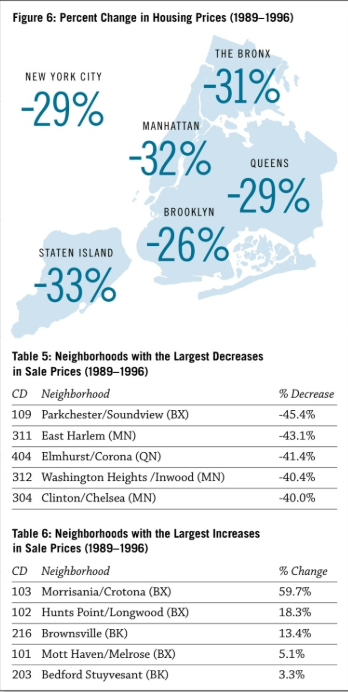
Instead, from 1974–1980, prices fell by 12%, from 1980–1989, the market zoomed forward 152%, and then it contracted by a sharp 29% from 1989–1996. The final episode in this particular report is a rise in values from 1996–2006 by 124%, but with hindsight, we can now add the spectacular 2008 bust and equally stunning rise from the ashes in 2012.
This roller coaster went very well for all who rode it for the long term, and those who managed to buy in a dip and sell in a peak made a quick fortune. But these numbers make clear that real estate does go down, too, and if Shloimy jumps in without caution, he can lose plenty.
“Buy When There’s Blood in the Streets.” The quote above is attributed to N.M. Rothschild, who supposedly profited (coldheartedly) in 1815 from his early knowledge of the outcome of the Battle of Waterloo. Historians believe that the quote and story are anti-Semitic fabrications, but buying low and selling high is definitely wise.
Yet, most do the opposite: during boom times, they buy, enticed by recent gains, only to hold off or even sell during the busts, thus locking in a depressed financial future. It takes a very strong stomach to go against common knowledge, and very few can do it.
For example, during the down times, out-of-favor properties like distressed malls and large Midwestern office buildings can often be bought for literally pennies on the dollar. At times like that, the marketplace assumes these properties are doomed; would you bet against that and risk your money? If so, you may become as rich as Rothschild…or lose it all.
Want to dig deeper?
Try these related articles
Managing The Risks Of Real Estate Investing
Real Estate Investing: An Ever-Changing Opportunity and Challenge